
Cyberpunk Classic 400 Boys Reimagined in Netflix’s Love, Death & Robots
Marc Laidlaw penned 400 Boys in 1981 at age 21, well before his role as lead writer for Valve’s iconic Half-Life series. First published in Omni magazine in 1983, the story later gained traction in Mirrorshades: The Cyberpunk Anthology, reaching a broader readership. On his website, Laidlaw notes that 400 Boys has likely been read by more people than anything else he’s written, aside from perhaps Dota 2 promotional content. While best known for his work on Half-Life, Laidlaw’s creative contributions extend far beyond gaming. Life has a funny way of unfolding.
In a ravaged city where rival gangs uphold a samurai-like code, the emergence of the 400 Boys unites them in conflict. Directed by Canadian filmmaker Robert Valley, whose Emmy-winning “Ice” episode captivated audiences, this adaptation blends raw beauty with unrelenting intensity.
“The idea sparked from just wandering around,” Laidlaw recalls. “Living in Eugene, Oregon, I’d see phone poles plastered with band names from local gigs. I wanted to capture that vibe. So, I thought, if I fill a story with gangs, I can invent all these wild names. That was half the fun—dreaming up those names shaped a big chunk of the story.”

Four decades after its debut, 400 Boys has been transformed into an episode in the fourth season of Netflix’s acclaimed animated anthology, Love, Death & Robots. Directed by Robert Valley, known for Zima Blue and Ice from earlier seasons, and written by Tim Miller, the episode features John Boyega, celebrated for his role as Finn in Star Wars. Suddenly, 400 Boys is stealing the spotlight. Laidlaw never saw it coming.
“The story kind of faded into the background, but cyberpunk stayed alive,” Laidlaw shares during a video call just before the Season 4 premiere of Love, Death & Robots on Netflix.
Forty years is a long wait for an adaptation, isn’t it? About 15 years ago, Tim Miller from Blur, a studio known for stunning video game cinematics, reached out about possibly adapting 400 Boys. The project fell through amid studio shifts, as many do.
Then, in March 2019, Love, Death & Robots burst onto Netflix. This bold, adult-oriented anthology was unlike anything else on the platform—some episodes provocative, others strange, all impossible to ignore. Laidlaw noticed Tim Miller’s involvement. “I couldn’t imagine anyone else turning J.G. Ballard’s The Drowned Giant into an animated episode,” he says. “Tim earned my respect for that alone.”
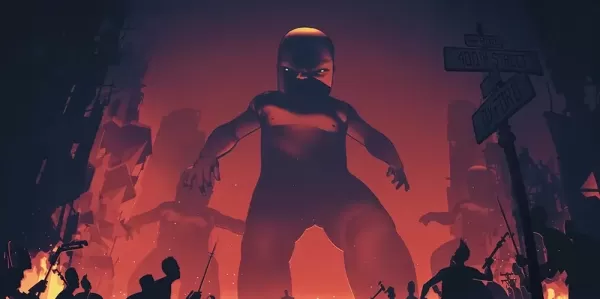
In 2020, Laidlaw relocated to Los Angeles and, as the pandemic subsided, crossed paths with Miller at local events. He didn’t push 400 Boys, but quietly hoped the anthology’s success might revive the idea. A year ago, he received an email asking if he’d be open to optioning the story. It was finally happening.
Laidlaw discussed the story with Miller, who adapted the script, and found the episode stays true to its roots while adding visuals that enhance its impact. He also spoke briefly with director Robert Valley, sharing an audiobook version of 400 Boys he’d narrated during the pandemic for online audiences.
Laidlaw stayed largely hands-off. “It was refreshing to step back and not be in the thick of it for once,” he says. “I just wanted to see what they’d create and enjoy the result.”
He’s seen the episode, of course. “John Boyega, the characters, the accents, the setting—it’s so vibrant. They made the story so much more dynamic visually.”
Laidlaw calls 400 Boys a piece from “a different version of me, lifetimes ago.” Written in his early twenties, he’s still proud of it. “I’m happy with it, considering how young I was.”
“Then came a long stretch of quiet,” he says. In 1997, he joined Valve as it developed Half-Life, and “everything just took off from there.”
Laidlaw left Valve in 2016, a departure that felt like a full exit from the industry. In reality, he’s in a place where he can pursue projects on his terms. “I retired too hard,” he admits with a laugh. He never intended to stop creating. Writing was always the goal, but the publishing world shifted dramatically while he was immersed in games. New video game projects? Not likely. “I can’t make a game alone—it takes a team.”
Now, Laidlaw channels his creativity into music. His audience grew after Valve’s Half-Life 2 anniversary documentary last year, when he shared a rare development video from the game’s early days on YouTube. “I’m in the wrong business!” he jokes. “I should just leak old Valve secrets.”
Reflecting on the Half-Life documentary, was it strange revisiting that era? “It was cathartic,” Laidlaw says. “Seeing old friends, tying up loose ends, talking it through—it was good for me.”
“I haven’t seen some of those people in years. I keep in touch with a few, but most have moved on. I don’t know what’s happening at Valve now, but reconnecting was fun and healing.”
With the Half-Life and Half-Life 2 documentaries behind him, only Dota 2—now 12 years old—remains as a potential Valve retrospective. Maybe in eight years, they’ll call. “I could talk about Dota,” he says. Or perhaps Alien Swarm, where he contributed a bit.
Talking to Marc Laidlaw inevitably circles back to Half-Life. With the Valve documentaries out, there’s little left to say about the past. But what about the future? I want to tug at that thread.
Asking if Half-Life 3 is in development is pointless. Laidlaw doesn’t know the current Valve team, and even if he did, he wouldn’t spill here. Instead, I ask if he’d write for a game again. He’s open to it, he says, even joking that Hideo Kojima should’ve called for Death Stranding. “I was grinding my teeth watching it, thinking, ‘Does he know I’m available?’ I’d love to polish dialogue, make lines sing for actors without breaking the story.”
Laidlaw’s hard retirement may have signaled to the industry that he was done. “I expected more interesting offers after Valve,” he says. “Instead, I got things like a synopsis for a mobile laser tag game. They don’t get what I do.”
Really? A mobile laser tag game? “Yeah,” he laughs. “I don’t like saying no, but that wasn’t for me.”
No compelling game projects have come his way since. “People think I’d write reams for a game, but did they notice how little writing was in Half-Life? That was deliberate—I hated heavy text in games.”
The big question: if Valve called about Half-Life 3, would he return? “No,” he says firmly. “I wouldn’t. Even at Valve, I started feeling like the old guy shutting ideas down. You need fresh voices—fans and creators inspired by what came before. I’d be the one saying, ‘The G-Man wouldn’t do that.’ I had to hold back to avoid stifling creativity.”
“I haven’t played Half-Life: Alyx in VR, so I’m out of touch. I’m not at the cutting edge anymore, and that’s not what drives me now. Game dev is grueling, and I can’t keep up. I’m done with Half-Life.”
So, Marc Laidlaw and Half-Life are done with each other. But his past work remains relevant. Netflix’s adaptation of 400 Boys, 40 years later, proves it. Perhaps one day, Netflix will approach Valve about Half-Life. Then Laidlaw might revisit this cycle again.
“I stumbled into cyberpunk before it had a name, then joined this small game company that made Half-Life. I’ve been lucky to be part of these things that just explode.”





-
1
Apex Legends keeps falling down in concurrent player count
Dec 30,2024
-
2
Alien: Romulus 'Fixed' Terrible Ian Holm CGI for Home Release but Fans Still Think It’s Pretty Bad
Mar 03,2025
-
3
Roblox: Notoriety Codes (January 2025)
Jan 17,2025
-
4
Roblox: Get Exclusive "Squid Game" Season 2 Codes for Epic Rewards
Feb 20,2025
-
5
Roblox King Legacy: December 2024 Codes (Updated)
Dec 24,2024
-
6
Metaphor: ReFantazio Releases New Update for January 2025
Feb 20,2025
-
7

Call Of Duty: Black Ops 6 Beta Testing Dates Confirmed
Jan 05,2025
-
8
Sakamoto Puzzle Unravels in Japan
Jan 27,2025
-
9
Marvel Rivals Debuts Midtown Map Update
Feb 02,2025
-
10
Anime Auto Chess: January 2025 Trait Tier List Update
Mar 13,2025
-
Download
Magnet Hero
Action / 45.6 MB
Update: Feb 11,2025
-
Download

Bulma Adventure 2
Casual / 57.55M
Update: Mar 09,2024
-
Download

Raising Gang-Girls:Torment Mob
Role Playing / 39.42M
Update: May 06,2023
-
4
Rusting Souls
-
5
Brawl Box Stars Simulator
-
6
Love and Deepspace Mod
-
7
Learning Color Shapes for kids
-
8
VRNOID demo(Meta Quest)
-
9
IDV - IMAIOS DICOM Viewer
-
10
كلمة السر